 Behavioral Experiment
A CBT worksheet, on paper, online, or in an app
Find out what actually happens.
Anxious thoughts make confident predictions. I will freeze. They will notice. I will not cope. A behavioral experiment is a way to check one of those predictions against real life instead of taking the thought's word for it.
Free. No account. Nothing you write is sent anywhere.
What it is
Behavioral experiments are one of the core tools of cognitive behavioral therapy. You write down a belief as a prediction you could see or hear coming true, rate how much you believe it, plan a situation that would test it, decide which of your usual precautions to leave out, and then go and look. Afterwards you record the facts, re-rate the belief, and write down what the result tells you more generally.
The Oxford Guide to Behavioural Experiments called them among the most powerful methods in cognitive therapy, because people learn through direct experience rather than argument. A later guide from the same group set out the seven steps that this worksheet follows.
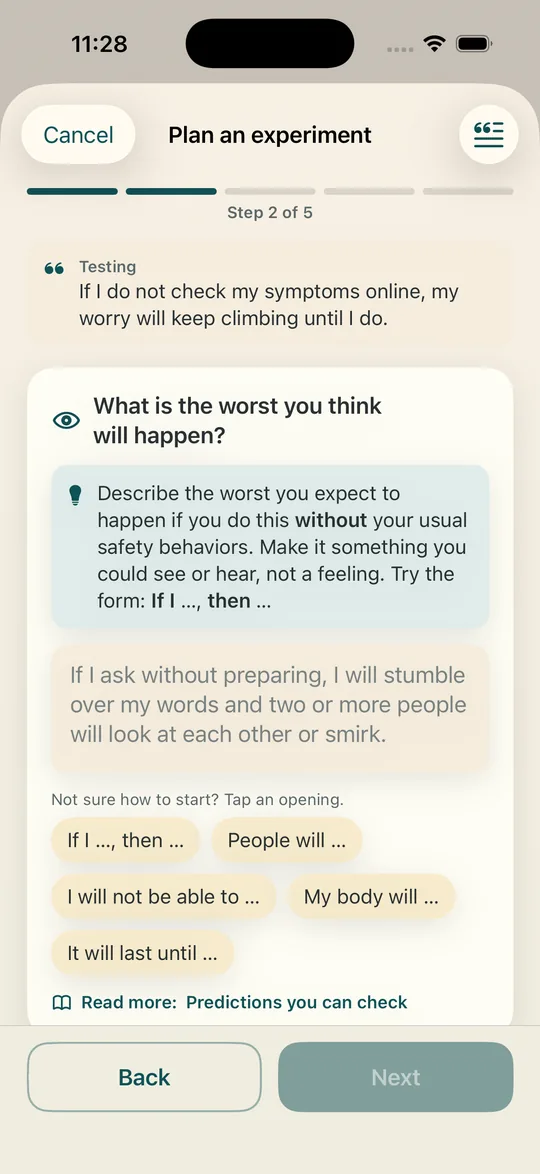
You can do one on paper, in your browser on this site, or in the free iPhone and iPad app. All three are the same worksheet. The app adds reminders, a step ladder that tracks your climb, and a one page summary you can hand to a therapist.
A worked example
If I speak without rehearsing, people will think I am boring and stop talking to me. 80%
Lunch in the break room on Tuesday, with the two colleagues who usually sit near the window.
If I start a conversation without planning what to say, they will give one-word answers, look at their phones, and leave within a few minutes. 70%
Rehearsing lines in my head. Keeping my eyes on my food. Agreeing with everything.
I asked what they were doing at the weekend. They both answered and one asked me the same. They stayed until they had finished. Nobody looked at a phone while I was talking.
People seem to respond to what I ask, not to how polished I sound. The boring feeling was inside me, not in the room. 45%
The steps
- Name the beliefWrite the worry as a prediction, and rate how much you believe it from 0 to 100.
- Choose the situationThe best test you are willing to try now, not the scariest thing you can think of. Real situations, out in the world.
- Make the prediction observable"I will be boring" cannot be checked. "People will look at their phones and leave within a few minutes" can.
- Decide what to leave outSafety behaviors are the precautions that feel helpful and quietly stop you from finding out. Name the ones you will drop, and where your attention will go instead.
- Do it, and watchAttention outward, on what people actually do. Stay until the prediction has really been tested.
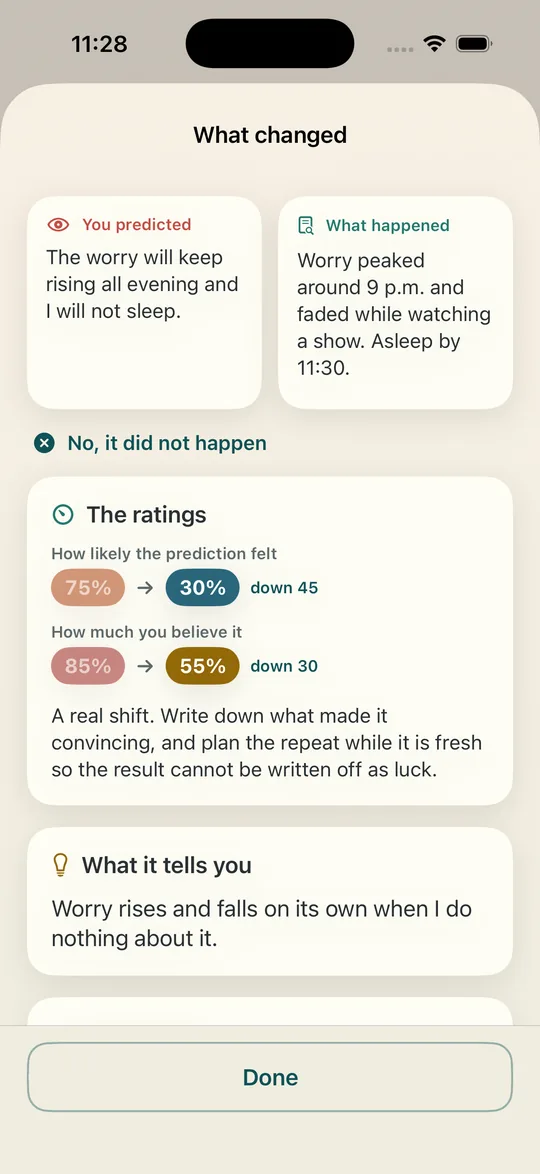
- Record the facts and re-rateWhat a camera would have seen. Then rate the prediction and the belief again.
- Draw the lesson and build on itWhat does this say about the belief more generally? Listen for the "yes, but" and turn it into the next experiment.
The full guide, with what to do when the feared thing happens
When the goal is too big
Sometimes the best test of a fear is too much to attempt straight away: the presentation, the highway, eating alone in a restaurant. A step ladder breaks it into rungs. You list situations from nearly easy to the goal itself, rate each one for how much distress you expect, and climb one rung at a time, repeating each until it feels solid.
Every rung can be run as an experiment of its own, which is what turns a ladder from plain exposure into learning.
For therapists
Two printable worksheets, a behavioral experiment record and a step ladder, laid out to be filled in during a session and taken home. Plus notes on how the app fits alongside therapy, including a session summary export that gives you the rating trajectory, the experiments in order, and the client's own learning statements on one page.
The app
The same worksheet, with a memory
The iPhone and iPad app walks you through each step with guidance and worked examples, keeps every belief and its experiments together, shows the rating over time, and can remind you when an experiment is due. There is a screen for while the experiment is happening, a step ladder that suggests when to move up, and a session summary for your therapist.
No accounts, no ads, no analytics. Everything stays on your device unless you turn on iCloud sync. English and Spanish.
Common questions
Is this therapy?
No. It is a structured worksheet and a set of educational articles, drawn from published cognitive behavioral therapy methods. Reading about a method and filling in a worksheet is not the same as receiving treatment, and nothing here is advice about your situation. Many people use worksheets like this one between sessions with a therapist, and that is the setting they were designed for.
Can I do this on my own?
Many people do, and there is reasonable evidence for self-guided CBT, especially with some support. The article on working alone or with a therapist goes through what the research says and when it is better to get help first. If a belief is about a traumatic memory, a real medical risk, or thoughts of harming yourself, work on it with a professional rather than on your own.
What is the difference between this and exposure?
Exposure asks you to stay in a feared situation until the anxiety fades. A behavioral experiment asks whether the thing you are afraid of is actually true. The goal is new learning, not a lower anxiety score, which is why you rate the prediction rather than the feeling. More on the distinction.
What if the thing I am afraid of happens?
Then you test the second half of the fear: was it as bad as you expected, how did people actually respond, and for how long did it matter? The real cost usually turns out far smaller than the imagined one, and that is often the more useful discovery.
Where does my writing go?
Nowhere. The online worksheet saves in your own browser on your own device. The app stores everything on your phone, and only copies it to your personal iCloud account if you turn sync on. We have no server and never see what you write. Privacy policy.
Does it cost anything?
No. The website, the worksheets, the PDFs, and the app are free, with no ads and nothing to buy inside.
Who made this?
Everyday Insight LLC, a small California company that also makes Values Card Sort and Activity Record. The worksheet follows the structure described by Bennett-Levy and colleagues (2004) and Warnock-Parkes and colleagues (2025); the research page has the references.